Hanging pieces and how to stop blundering in Chess

35 free video lessons, each tagged by level

What coaches agree on

  • Before every move, run through the same short scan: what checks, captures, and threats are available to you, and what your opponent could play in reply.
  • Before you play a move, check what it gives up: what square it stops defending, what check it allows, or what tactic it hands your opponent, not just what it achieves for you.
Show more
  • Count the attackers and defenders on any piece before judging its safety: equal numbers make it a loose piece worth watching, and more attackers than defenders makes it hanging outright.

Common mistakes

  • Tunnel vision is a common trap: locking onto your own plan or one side of the board, often the side you are attacking, makes you miss threats and hanging pieces elsewhere, including on the far side of the board.
How to Actually Avoid Blunders in Chess
Intermediate
How to Actually Avoid Blunders in Chess

Reviewer Changes how you review your own games, not just this one - strong stuff.

Moderator Title is the sub-skill. He goes further than most by pushing back on chess.com/Lichess's '??' labeling and showing which flagged moves are real blunders vs just imprecise - several of the real ones are textbook hanging pieces (a knight taken for free, a pawn dropped by ignoring a threat). Squarely on topic and more rigorous than average.

3.8
Why You Keep Hanging Pieces in Chess
Beginner
Why You Keep Hanging Pieces in Chess

Reviewer Clean, memorable framework backed by real examples at every level — teach this to anyone who blunders.

Moderator The checks-captures-threats scan IS the sub-skill — this video's entire structure is built around teaching and then re-applying that one framework across rating bands.

3.8
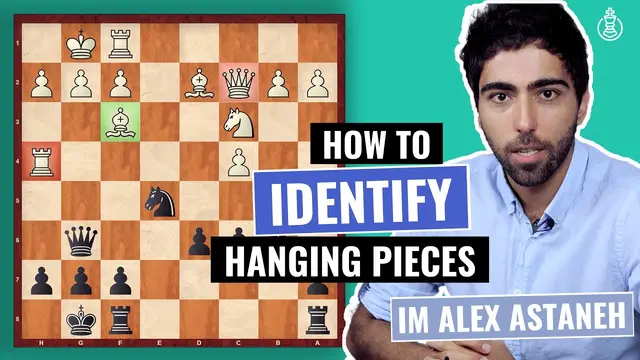
How to identify Hanging Pieces | Beginner Level | IM Alex Astaneh | 2D
Beginner
How to identify Hanging Pieces | Beginner Level | IM Alex Astaneh | 2D

Reviewer Catches a nuance most beginner content misses, and grounds it in a real top-level game.

Moderator Entirely and precisely about hanging pieces: builds the definition carefully (including the nuanced case where a defended piece is still 'hanging' because the capture is favorable), then applies attacker/defender counting throughout a real Kramnik game.

3.8
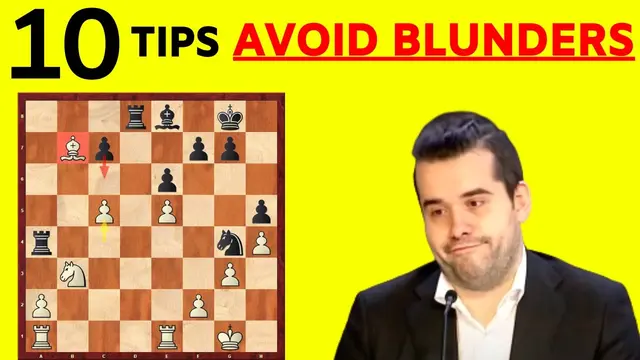
10 Useful Tips to Avoid Blunders in Chess | How to Blunder Less
Beginner
10 Useful Tips to Avoid Blunders in Chess | How to Blunder Less

Reviewer One of the better ones in this batch -- clear rule, real examples, immediately usable.

Moderator Textbook on-topic -- defines hanging pieces explicitly, walks through Christiansen-Karpov and a Carlsen world championship game where a bishop gets trapped because it's the one piece not supported by others.

3.7
Hanging Piece Chess Tactics - Beginner To Master
Intermediate
Hanging Piece Chess Tactics - Beginner To Master

Reviewer Builds from trivial to genuinely tricky - the puzzle about picking rook over bishop while ignoring a mating net is a great lesson on its own.

Moderator Opens with the textbook definition of a hanging piece and then runs a genuine progression of puzzles built entirely around finding them - can't get more on-topic than this.

3.7
Chess Mistakes? | Hanging Pieces! | ChessKid
Beginner
Chess Mistakes? | Hanging Pieces! | ChessKid

Reviewer About as good as beginner tactics teaching gets — concrete, correct, and it builds.

Moderator Textbook-perfect match — defines hanging pieces, then walks a full sequence of concrete captures on one board from both colors' perspectives.

3.7
How To Avoid Blunders In Chess [Anti-Blunder Checklist]
Intermediate
How To Avoid Blunders In Chess [Anti-Blunder Checklist]

Reviewer Clear, memorable rule with a real example - the kind of thing you can actually use next game.

Moderator Dead center of the skill - a named, repeatable checklist (after opponent moves check attacks, before you move check blunders) built specifically to stop the exact failure mode this sub-skill is about. Illustrated with a real recurring trap so it's not abstract.

3.6
3 Brain Habits To Stop Blunders EASILY– Chess Tips
Intermediate
3 Brain Habits To Stop Blunders EASILY– Chess Tips

Reviewer Three habits worth stealing - the landing-square rule alone will save you pieces.

Moderator This is a blunder-prevention lesson built entirely around spotting hanging/undefended pieces before you move. Tip one is 'danger first' - scan for undefended pieces every move. The landing-square rule and the 1-second rule are both about not creating a new hanging piece with your own move. Every example he shows is a piece left en prise or about to be. Dead center of the sub-skill.

3.6
How to Find Tactics Like a Master: Spot Loose Pieces and Win More Games
Intermediate
How to Find Tactics Like a Master: Spot Loose Pieces and Win More Games

Reviewer One of the strongest here -- a real method, not just examples.

Moderator This is the flip side of the same coin -- spotting loose (hanging) pieces to win material rather than to protect your own, but it's the identical pattern-recognition skill the sub-skill is about, with real Karpov/Anand games.

3.5
You’re 22 Minutes Away From Never Blundering Again
Beginner
You’re 22 Minutes Away From Never Blundering Again

Reviewer The CCTO framework alone is worth the watch - simple and it actually works.

Moderator Direct hit on 'how to stop blundering' - defines two blunder types (your mistake vs missing theirs), then builds a repeatable process. Several of the walked examples are literally 'this piece/pawn is hanging, what do you do about it', so it overlaps hanging pieces specifically, not just blunders in the abstract.

3.5
The ABC Check — How I Stopped Hanging Pieces (FREE Cheat Sheet)
Beginner
The ABC Check — How I Stopped Hanging Pieces (FREE Cheat Sheet)

Reviewer Honest, concrete, and testable — shows exactly how skipping the check cost real games.

Moderator Entirely built around one blunder-prevention habit (after their move check for attacks; before your move check for blunders), illustrated with the presenter's own real blunders. No digressions.

3.5
THIS Is Why You Keep Blundering ❓❓
Intermediate
THIS Is Why You Keep Blundering ❓❓

Reviewer Turns a real blunder into a one-line habit you can start using in your very next game.

Moderator Names the actual mechanism behind a huge share of real blunders - tunnel vision on your own plan - and gives a concrete recurring question to ask after every opponent move. This is squarely 'how to stop blundering' territory, arguably one of the most important single habits in the whole topic.

3.4
This One Question Could Stop Most of Your Blunders
Intermediate
This One Question Could Stop Most of Your Blunders

Reviewer Sharp, concrete, and teaches something most blunder-advice misses.

Moderator Squarely on the sub-skill — a specific, well-chosen question ('what am I unprotecting') for catching hanging pieces before you move, shown on two real positions.

3.4
The Easiest Way to Stop Hanging Pieces
Beginner
The Easiest Way to Stop Hanging Pieces

Reviewer Covers both the obvious threats and the sneaky discovered-attack case most similar videos skip.

Moderator Entirely built around a 3-step blunder-check system (hands off the mouse, trace attack lines, check for discovered/hidden attacks) — every minute is on-topic.

3.4
0 Elo Chess: How a Single Blunder Lost the Queen and Turned ...
Beginner
0 Elo Chess: How a Single Blunder Lost the Queen and Turned ...

Moderator This is squarely about why pieces get hung and how to stop it -- it names the actual checking habits, watching for a bishop's diagonal before playing into it and asking 'can this be taken in one move' before every move. That second point in particular is exactly the core skill for a player at this level.

Reviewer Blunt delivery, but the actual advice -- check for the one-move capture, every single move -- is exactly right.

3.3
Chess Tactics : Tactic: Hanging Piece
Beginner
Chess Tactics : Tactic: Hanging Piece

Reviewer Great first intro to spotting hanging pieces, though a bit repetitive and only half the picture.

Moderator Literally titled 'Tactic: Hanging Piece' — defines the concept in plain terms and works through several examples of spotting and capturing an opponent's undefended piece. Squarely on-topic.

3.3
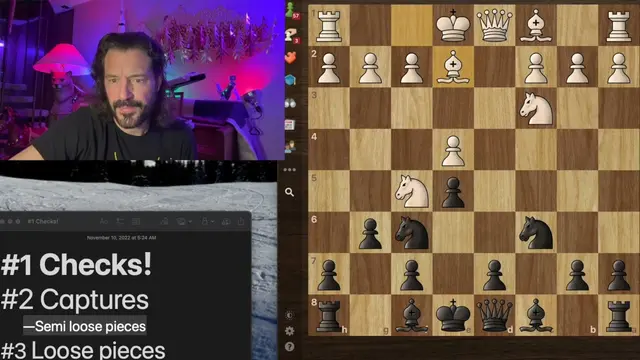
Hanging pieces  for intermediate chess players
Intermediate
Hanging pieces for intermediate chess players

Reviewer Teaches real vocabulary - semi-loose pieces, removing the defender - worth it.

Moderator Title says it and the content delivers - a full class session built around a hanging-piece puzzle set for intermediate students, explicitly framed as needing more than a free grab (defender removal, simplification first). Squarely the sub-skill.

3.3
How to STOP BLUNDERING and MISSING TACTICS (forever)
Beginner
How to STOP BLUNDERING and MISSING TACTICS (forever)

Reviewer Practical and repeatable, if a little basic -- good habit-building, not a deep dive.

Moderator Squarely on-topic. The whole video is the mental checklist for spotting hanging pieces before you move -- what's protected, what a pawn push reveals, playing slower time controls so you actually have time to check. This is exactly the sub-skill.

3.1
The Simple Mental Checklist That Stops Chess Blunders
Intermediate
The Simple Mental Checklist That Stops Chess Blunders

Reviewer A little course plug up front, then genuinely sharp analysis of a real blunder.

Moderator Directly about spotting hanging pieces / avoiding blunders via a checklist — the sub-skill in action, worked through a real position.

3.1
How to stop blundering!! Edge to chess episode 8 ♟️ ...
Beginner
How to stop blundering!! Edge to chess episode 8 ♟️ ...

Reviewer Clear, honest routine that a beginner can start using tonight, it just takes a lot of reps to stick.

Moderator A beginner blunder check in two minutes: notice what your opponent's last move attacks, look beyond the piece that moved to spot hidden attacks (a rook hits a bishop, and your queen is behind it), then run through their forcing moves, checks, captures and threats, before you play. That's the core habit for not hanging pieces.

3.0
How to Stop Hanging Your Pieces: 3 Common Blunders Explained
Beginner
How to Stop Hanging Your Pieces: 3 Common Blunders Explained

Reviewer Good exercises and a real concept, but it keeps pausing to advertise the presenter's own course.

Moderator Entirely about hanging pieces — three named mechanisms (unsafe landing squares, tunnel vision on one side of the board, multi-purpose moves that miss a threat), each demonstrated with a worked exercise.

3.0
How to Stop Chess Blunders: Ranked 0–10
Beginner
How to Stop Chess Blunders: Ranked 0–10

Reviewer Good checklist you can run every move; it would be better with a position or two to show it.

Moderator On target: habits for blundering less - slow down, stop when tilted, solve tactics, check all checks, captures and threats, review every blunder, ask what changed after each move, calculate the opponent's best reply, and do a final blunder check. About stopping blunders in general; hanging pieces are covered only implicitly, through the checks-captures-threats scan.

2.7
Checks, Forks & Pins Comment MASTERCLASS, and I'll ...
Beginner
Checks, Forks & Pins Comment MASTERCLASS, and I'll ...

Moderator Spotting hanging pieces starts with recognizing checks, forks, and pins, and this goes right at that with a real Fischer game as the example. It's squarely the foundation of this sub-skill.

Reviewer Compact and clear -- a good starting point for the three patterns that cause most blunders.

2.7
How to Reduce Your Chess Mistakes Significantly!
Intermediate
How to Reduce Your Chess Mistakes Significantly!

Reviewer Concrete advice, backed by a real game.

Moderator It's framed as blunder-reduction for beginner/intermediate players, which is the second half of this sub-skill's name, using a real annotated master game -- on-topic even though it doesn't zoom into 'hanging a piece' as its own narrow mechanic.

2.6
Hanging Pieces? Here's How to Stop
Beginner
Hanging Pieces? Here's How to Stop

Reviewer Good checklist and a catchy mnemonic, but the 'equal count means you're safe' rule is oversimplified and can mislead.

Moderator Entirely built around a 4-point checklist (hanging pieces and checks for both sides) walked through move-by-move in a real game, plus a CPR mnemonic for responding to checks. Squarely on topic.

2.6
How To Avoid Making Blunders | ChessKid
Beginner
How To Avoid Making Blunders | ChessKid

Reviewer Fun, clear, and the queen-safety puzzle is worth your time - part of the video is about tournament etiquette rather than the pattern itself.

Moderator Real tournament position built entirely around not blundering the queen onto an unsafe square, plus a genuinely practical rule for the touch-move situation (put it back on a safe square, then take your time). A good chunk of the video is about the touch-move procedure itself, which is more etiquette than pattern recognition, so I'm not calling this a perfect bullseye, but it's clearly serving this sub-skill.

2.3
5 Chess Blunders to Avoid || Smart Tricks & Winning Tips!
Beginner
5 Chess Blunders to Avoid || Smart Tricks & Winning Tips!

Reviewer Correct and tidy, but a bit paint-by-numbers - useful refresher, not a deep lesson.

Moderator Lead mistake is leaving hanging pieces, with two illustrative scenarios (careless hang, and removing your own defender by accident) - both textbook hanging-piece failure modes. The other four items are broader blunder categories, which is still squarely 'how to stop blundering.' Very on-topic overall.

2.3
Top 10 WORST Blunders By Chess Grandmasters
Intermediate
Top 10 WORST Blunders By Chess Grandmasters

Reviewer Fun watch, but light on actually teaching you how to avoid the same mistakes.

Moderator Explicitly framed around historical blunders by grandmasters, which is squarely thematically on-topic for 'how to stop blundering' — though the actual analyzed example (Chigorin-Steinitz) is more a strategic/initiative misjudgment than a clean hanging-piece tactic.

2.2
Chess instincts that save games: how puzzles prevent ...
Intermediate
Chess instincts that save games: how puzzles prevent ...

Reviewer A good, honest example of the habit paying off -- just wish it went further.

Moderator This is a real-time example of exactly the habit this sub-skill is about -- pausing before a natural-looking move to check what the opponent can do, and catching a fork that would have thrown the game away. It's a live demonstration of the scanning instinct, credited explicitly to puzzle practice.

2.1
3 SECRET TIPS To Stop Blunders in Chess
Intermediate
3 SECRET TIPS To Stop Blunders in Chess

Reviewer True and worth hearing, but it's mindset advice more than a method.

Moderator Uses real games (an 1800 amateur game, a GM game Vallejo-Santos) to show blunders happening and being missed by both sides — squarely about the blundering problem, though the angle here is more psychological resilience than a prospective checklist.

2.1
Beginner Chess Chaos: 100 ELO Blunders, Tactics & ...
Beginner
Beginner Chess Chaos: 100 ELO Blunders, Tactics & ...

Reviewer Entertaining, and it does show how pieces get left hanging, but the jokes outweigh any clear method for stopping blunders.

Moderator Commentary through a roughly 100-rated game full of loose pieces: a hanging knight, then a hanging bishop, two pieces en prise at once, a pawn capture nobody saw, and a tactic that leaves a rook hanging. Points out where each piece was unprotected and what the safer move was. Largely on topic, though it drifts into checks, castling and king safety.

1.4